Over a long period of time, power has been centralised away from local councils, and their funding has been drastically reduced, both during the post-2011 austerity drive and during Covid. 

Councils are vulnerable to defunding because they are in an impossible situation, and therefore tend to be unpopular: even when they work well,  they lack the powers and funds to provide what many people expect. National regulations often mean they have to do unpopular things. Defunding leads to problems in their internal organisation too, such as overreliance on consultants. People often don’t understand local politics, and either don’t vote, or vote along lines of national party allegiance.

But the climate transition requires a massive transportation in our local environments: in how we manage our buildings, work, town centres, transport systems, and green spaces. Climate politics is always necessarily local and practical. Getting involved is a great way to bring meaning back to local politics, and restore its power.

We would like to see both local people and national government reinvest in local councils. Building local institutions, and ensuring they have the resources and expertise to plan climate mitigation and adaptation, is going to be one of the most important ways to respond to climate breakdown. 

Climate emergency planning

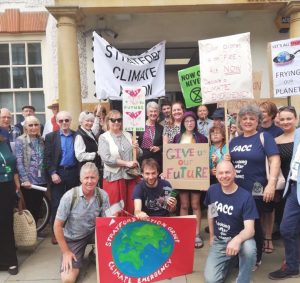
Stratford District Council, Warwickshire County Council, and several local tier councils (including Stratford Town Council) have all declared a climate emergency and set targets for achieving net zero emissions across their territory, partly in response to our campaigning. In varying degrees they are planning for their role in the transformation. Sometimes they are ahead of national government, and lobby for stronger national action, which will be necessary to achieve their targets. This helps build grassroots pressure for stronger national action. Below, we set out what local councils are doing, how you can get involved, and what our response is to them.

Stratford District Council

In response to our campaigning, the District council initially committed to achieving net zero carbon emissions across the District by 2030. However, their planning approach is currently based on a high ambition scenario of 55% reductions by 2030 – the most important thing is that this is stronger than what the government is aiming for. You can read about this in an important report which SDC commissioned from the consultancy Anthesis.

The Council has a Climate Change Panel that meets in Elizabeth House once every six weeks, and is open to the public. At every other meeting, questions are invited from the public – these have to be submitted two weeks in advance. In our experience, this is a useful way to meet councillors, learn about what is going on, and to make them aware of the public interest in decarbonisation. 

We have asked Councils to survey all sources of emissions locally, and to use their leadership and collaborate with other organisations to drive carbon emissions across the board. However, what they can do directly is limited by their specific powers. You can learn about their current plans here. A key role of District Councils is in the planning system, and one of the main ways they are looking to do this is through developing a new South Warwickshire Local Plan, which will hopefully require all new build houses to be net zero in use. Another key role they have is in giving or withholding permission for specific projects, and we have been involved in campaigning for several solar farms.  

Warwickshire County Council

Warwickshire County Council also declared a climate emergency in 2050. However, they were less ambitious than Stratford District Council, refusing to set an emissions target more ambitious than the government’s 2050 net zero target.

The setting of a target seems to have had a direct effect on action. The District Council’s plans and programs of action are much more advanced than the County’s. For their latest action, see here. One of the key responsibilities of the County Council is to deal with transport, which is the biggest single source of local emissions. They are also currently developing a Sustainable Futures Plan. They are yet to develop a forum for public involvement in their planning, but we hope to persuade them to do so soon.

In order to lobby the Council for stronger action, but also to help provide them with constructive ideas, we set up a County-wide organisation, Warwickshire Climate Alliance. This organisation is an umbrella of groups engaged with climate action, and associated issues (air quality, sustainable transport, etc) across Warwickshire. You can read our response to their Sustainable Futures consultation here.

What can councils do?

There are some national organisations that provide information on local council action, and on what can be done.

Friends of the Earth is a national campaigning organisation, which leads the way in providing activists with the knowledge and materials they need. We are registered as a FoE climate action group. They provide information on actions councils can take, as well as case studies of leading councils.

Climate Emergency UK coordinated the original climate emergency campaign in 2019. They provide evaluations of council plans and actions, with links to council documents, which helps to identify what the most ambitious councils are doing.

UK100 is a cross-party organisation supporting the most ambitious councils to go further and faster on their Net Zero and Clean Air targets. Councils are asked to sign up to their pledge. They facilitate knowledge-sharing between members, partnership-building, collective lobbying of government, and provide leadership and outreach mentoring. Warwickshire County Council is a member but, disappointingly, Stratford District Council is not.