
By Jenny Loynds.
 Food and farming in the UK have a significant carbon footprint, accounting for one fifth of our carbon emissions. Additionally, the intensification of agriculture since the Second World War has resulted in steep declines in our wildlife, poor water quality in our rivers and lakes, and declining soil health. To tackle the climate crisis, while at the same time feeding the population with healthy, affordable food, we must accelerate efforts to change the way we produce our food. Regenerative agriculture is playing an increasingly important role in these efforts.
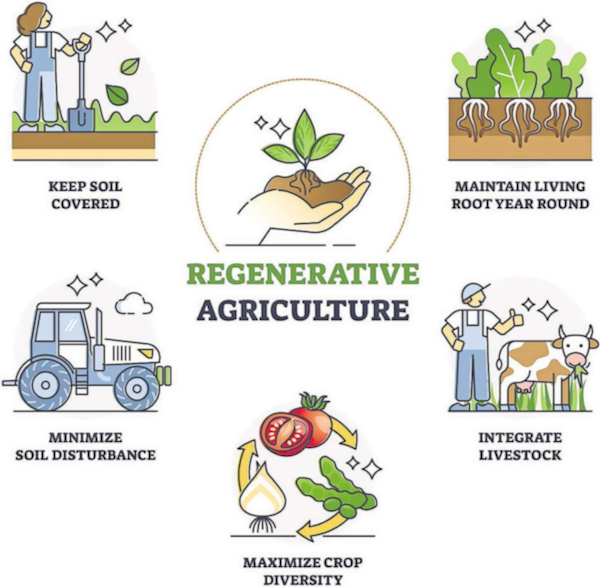
In conventional farming, the soil is treated as a medium to which fertilizers and chemicals are added. The soil is ploughed or tilled, herbicides, pesticides and fungicides are added, and lack of water is compensated for with irrigation. The purpose of regenerative agriculture, on the other hand, is to continually improve and regenerate the health of the soil by restoring its carbon content, which in turn improves plant health, nutrition and productivity. There are five key principles in regenerative agriculture, according to Groundswell, the UK event for farmers interested in improving soil health:
- No till. When soil is tilled and exposed to the air, the microbial life within it quickly decays and carbon is released. The less the soil is disturbed, the more life in the soil is increased.
- Cover crops. When cover crops are sown into harvested fields, they crowd out weeds and provide fertility to the soil. The greater the variety of cover crops, the greater the nutrients put back into the soil.
- Keep living roots in the soil. This practice is vital for feeding the creatures at the base of the soil food web which in turn feed species higher up the chain.
- Crop rotation. In conventional farming, this might be swapping one crop for another in alternating years. In regenerative agriculture, multiple crops are rotated which prevents pests from taking hold and brings distinct additions to the soil.
- Grazing animals. Introducing grazing livestock, particularly in a mob grazing approach where animals are moved frequently from one area to the next, boosts soil resilience and improves soil structure (although livestock do have their own carbon footprint which must be considered).
While the impact of regenerative agriculture is hard to measure and model as each farm has its own unique approach and conditions, farms that are embracing this approach are seeing organic matter levels in their soil increase by several percentage points over several years. When every percent of carbon in the soil represents 8.5 tonnes of carbon per acre, these changes are significant in reducing carbon emissions from farming.
Here in Warwickshire, where agriculture makes up 70% of our land, we are starting to see a more sustainable approach to farming with the creation of organisations such as the South Warwickshire Sustainable Farming Group. Embracing regenerative agriculture principles will help our farmers improve soil quality, increase carbon in the soil and restore our wildlife. We need to support our farmers as they make this transition. Feed the soil, heal the planet.