
By Stephen Norrie.
In debates over local solar farm proposals, a common argument is that we shouldn’t take land out of food production, due to concerns about food productivity, security and prices. Does this argument stack up?
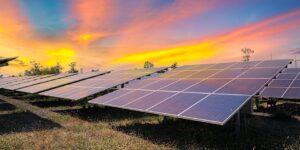
There is real cause for concern about future food production—mainly due to climate change, and the heatwaves, droughts and floods associated with climate breakdown. However, there is no evidence that we are confronted with a food crisis so immediate that no land whatsoever should be removed from food production. And in fact, the amount of land at stake is extremely small. Analysis by Carbon Brief has shown that currently 0.1% of British land surface is covered by solar farms. Even if all the solar farms implied by the government’s Net Zero targets were built, they would only take up 0.3%.
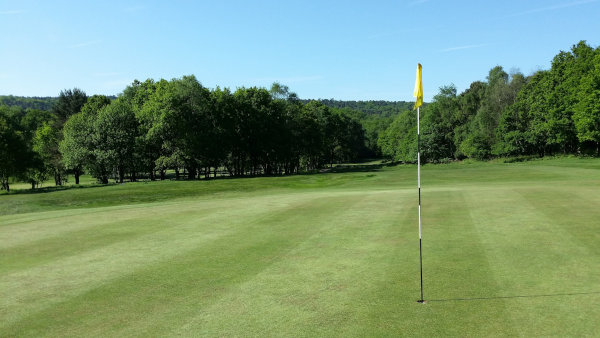
By comparison, golf courses take up around double that. And this comparison is revealing. An extra 0.2% of land is not a lot, but in a very severe food supply crisis, it might make sense to protect it for food production. However, in such a crisis, there would surely also be a big move to convert golf courses to food production. That no-one is suggesting this shows that no-one seriously imagines we are in such a situation. In short, the concern is being exaggerated to obstruct solar farms.
 Moreover, much of the land on which solar farms are planned is not producing food for humans at all. Most of these proposals are for Grade 3b land, officially described as “Land capable of producing moderate yields of a narrow range of crops, principally cereals and grass or lower yields of a wider range of crops or high yields of grass which can be grazed or harvested over most of the year.” For this reason, it is often devoted to crops sold for biofuels or animal feed. Government proposals to reclassify such land as “best and most versatile”—in order to thwart solar farms—thus make little sense.
If we are to respond strategically to concerns about future food supply, we would do better to look at land used for these purposes, rather than the small portion targeted for solar farms. Biofuel crops currently take up 77% more UK land than solar farms, whilst being much less productive in terms of energy. According to Carbon Brief, “a hectare of solar panels delivers between 48 and 112 times more driving distance, when used to charge an electric vehicle, than that land could deliver if used to grow biofuels for cars.”
Biofuel also compares poorly to food production: according to carbon accounting expert Mike Berners-Lee, the cereals used to power a car for a 1.1-mile drive could feed a person for a day. Clearly if we were just to convert the land devoted to biofuels to a mix of solar farms and food production, we could easily find the 0.2% portion necessary for solar farms while also increasing our food supply.
Animal agriculture is a major cause of greenhouse gas emissions, producing around 6% of emissions in Stratford District. It is also a highly inefficient way of using land to produce food. Mike Berners-Lee reports that animal agriculture converts only around 10% of the calories and 25% of the protein fed to animals into products eaten by humans. One study has suggested that over 75% of the world’s agricultural land could be freed up, without diminishing our food supply, if we stopped using so much of it to grow animal feed and instead embraced a plant-based diet.
As this shows, there are solutions to worries about our food supply, but opposing solar farms is not one of them. In fact, as climate breakdown is the biggest threat to agricultural production, rapidly transitioning to renewable energy is extremely important for securing our future food supply. Solar farms are an important part of that transition.
This article was originally published in the Stratford Herald in December 2022.