
By Steve Currie.
I have been puzzled about the Climate Crisis, public concern and why there appears to be an apparent reluctance to change.
In November last year, local environment groups organised a COP27 Town Centre Rally to demand more government action in tackling Climate Change. Two hundred people took part in a widely advertised Rally. I expected to see more people, especially given the UN Secretary Generals’ warning that humanity is on a “highway to climate hell”.
My curiosity about public concern continued and I discovered that the Office for National Statistics had conducted surveys to establish levels of climate concern in the UK population.
I was surprised to see the high levels of public concern.
The table below was published from their survey September and October, 2022.
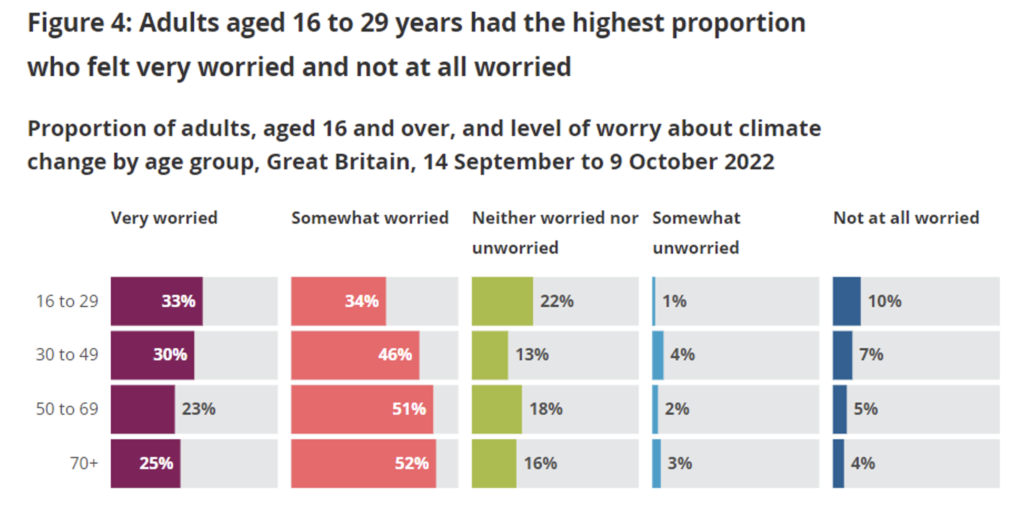
These O.N.S. results echoed our Net Zero Stratford surveys. So again, I wondered why people aren’t motivated to change?
Further armchair internet investigations found articles by Time Magazine, Hall & Partners, Harvard Business Review, and Stanford Social Innovation Review.
Each of them had employed behavioural psychologists to understand the paradox of our impending climate disaster and passive reaction.
My simplified reasons to explain why society does not act despite being worried are summarised below:-
- I’m O.K. The weather is fine today.
- I’ll worry about it later. I’ve got more urgent issues to worry about.
- I don’t feel threatened by it.
- No one else is doing anything about it.
- Net Zero by 2050, that’s 27 years away; I might be dead by then.
- It’s uncertain; nobody knows what will happen for sure.
- I can’t solve it; it’s too complicated and too big a problem for me to think about.
- I feel guilty (for not doing anything) and don’t want to talk about it. (The Elephant in the room).
- Magical thinking: The scientists will fix it, the Government will fix it, God will fix it.
Originally, I assumed that politicians would be the drivers of change, but I have concluded that they have too short a time to make change before standing for re-election.
So, it’s up to us, the voters, to demand and make change.
The last and most optimistic article was by psychologist George Marshall, author of Why Our Brains Are Wired to Ignore Climate Change; he claimed that humans are more inclined to believe information presented in a satisfying way, appealing to our ‘emotional brain’ and engaging us to think about climate change in a personal and relatable way.
In conclusion, ‘we’ can improve our Planet by doing very simple things:-
- Write to our Councillors and politicians to deliver net zero emissions by 2050 or sooner.
- Adopt the three ‘R’s :-
- Reduce: The amount of ‘stuff’ we consume, electricity, gas, things!
- Reuse: Everything that can be repaired, or re-purposed.
- Recycle: Everything to eliminate landfill dumping.
This is ‘OUR’ Planet and ‘OUR’ children’s future.
Let’s leave it in a better condition than the one that ‘WE’ have inherited.
Our articles are published each month in the Stratford Herald.

