By Stephen Norrie.
A 2011 art installation in Berlin, by Isaac Cordal, shows politicians debating climate change. Only their heads and shoulders remain visible above the rising waters they have failed to notice as they continue what Greta Thunberg calls their ‘blah blah blah’. Is this a fair evaluation of the latest round of international climate talks at COP26, which has just finished in Glasgow?
It would be dangerous—conducive to cynicism, despair and inaction—to pretend that nothing came from the event. In the run-up, China and the USA improved their decarbonisation pledges, and there are plans to increase collaboration between the two super-powers. India introduced new targets that would limit temperatures to 1.8°C by end of century – near the relatively safe, best case scenario of 1.5°C – if all pledges were met. However, this is a big ‘if’, as some of these pledges are transparently insincere.
For instance, the Australian pledge to achieve Net Zero by 2050 may be a landmark, but their plans are so clownishly inadequate that activists crowned them the ‘Colossal Fossil’, the laughing stock of the conference. Jair Bolsonaro, ‘Captain Chainsaw’, whose regime has been actively enabling record deforestation in Brazil, has signed up to a pledge to reverse deforestation by 2030? Really?
Others may struggle to deliver. Biden’s reform agenda in the US has stalled and been watered down by politicians in the pay of fossil fuel companies. Worse, inflation and gas prices have put the Republicans ahead in the polls, raising fears of the return of a science-denying Republican to the White House.
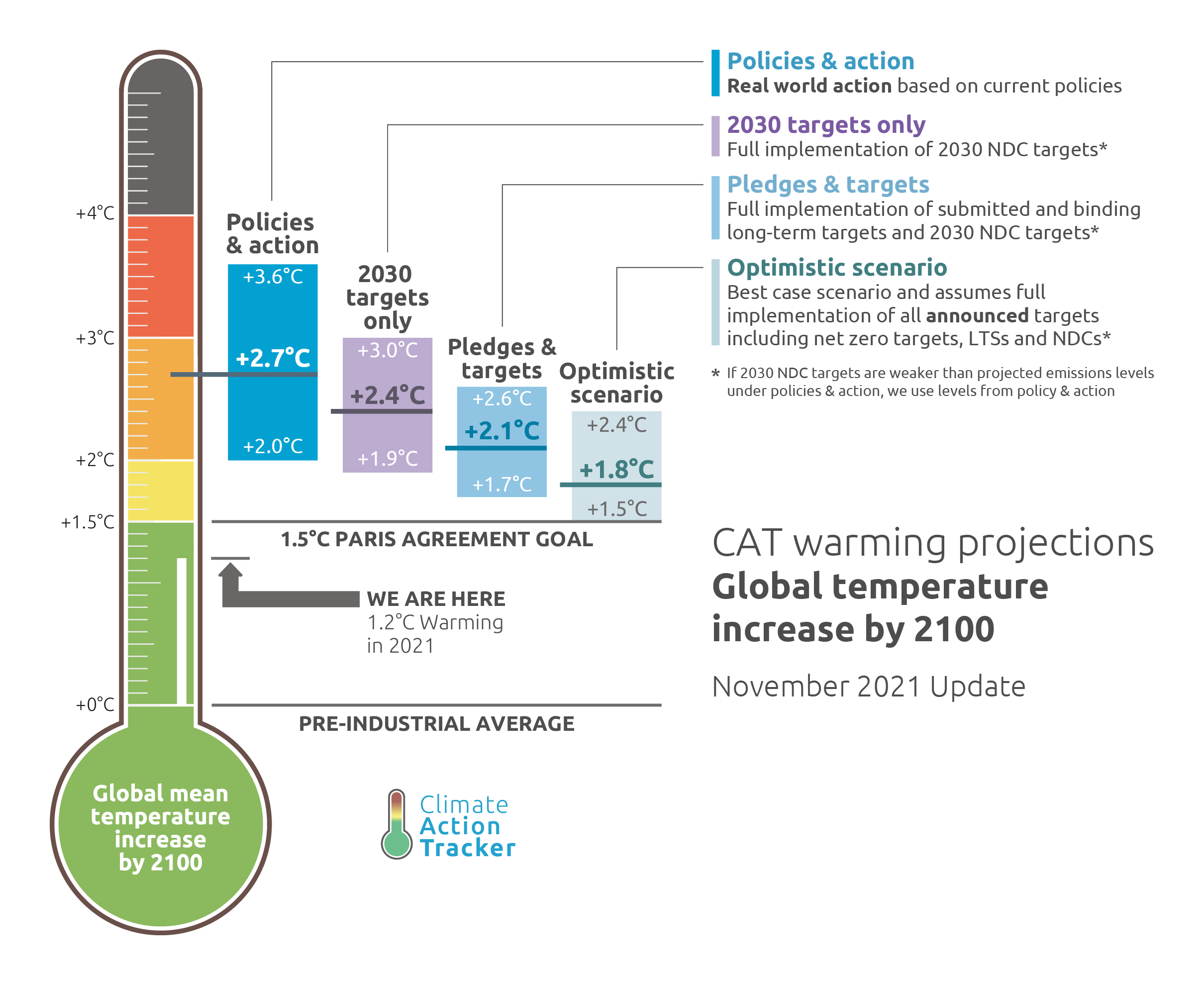 According to preliminary analysis by the authoritative monitor, Climate Action Tracker, likely end-of-century heating has now been bid down—to 2.7°C on current policies, 2.4°C if you add in 2030 targets, and to 2.1°C if you include the ‘binding’ 2050 targets too. There has, however, been no agreement to keep fossil fuels in the ground, as is necessary to limit heating to 1.5°C.
This is not good. If we end up somewhere around 2.5°C hotter at end of century, sea levels would be over half a meter higher, and rising rapidly every year, and cities like New York would suffer three Hurricane Sandys a year. Whole populations in South Asia and Africa would regularly experience temperatures above survivability or workability thresholds, and deadly heatwaves would be the summer norm even in Europe. Catastrophic droughts, desertification, and agricultural damage would extend from Africa to much of the Mediterranean. As we head towards 3°C, river flooding could more than triple in the UK. All this would displace hundreds of millions, and possibly billions of people. For comparison, the Syrian refugee crisis saw about 13.5 million people displaced.
If there is hope, it lies in the ramping up of negotiations and of activism. What made some progress possible this COP was that the Paris agreement required countries to ‘ratchet up’ their pledges every 5 years. This requirement has now been made annual, so that COP27 and COP28 will essentially continue the current discussions. From one perspective, this is kicking the can down the road. From another it means that climate pledges and policies should be a more permanent feature of our politics from now on.
COP26 also feels like it has extended the conversations we are having as activists. It has given us the opportunity to discuss things like the role of the financial system, and the often exploitative ways in which wealthy countries interact with the global South. If we want these countries to keep their coal in the ground, it is necessary to unravel these relations and secure them the financial aid they need to develop in a sustainable way. If we are to drive change in the world, it will be vital to continue to educate ourselves about these issues.

