
By Janet Palmer.
Do you ever wonder how the money accumulating in your retirement pot is invested? We all rely on our pension schemes to pay out when the time is right, but most of us don’t trouble ourselves to ask about the investments that are made on our behalf. At a time of climate emergency and a global energy crisis, that is a big mistake.
It may surprise you to learn that Warwickshire County Council’s local government pension scheme, designed to support WCC employees on retirement, still has about £94 million pounds invested in fossil fuel companies. This is at a time in our history when the UN Secretary General, Antonio Guterres, is telling us that “investing in new fossil fuel infrastructure is moral and economic madness.” Yet Warwickshire councillors have so far declined to divest (sell their fossil fuel stocks) in spite of the risk this carries. Councillors argue that “engagement” with the fossil fuel companies is their preferred strategy.
“Engagement” means that investors attempt to influence fossil fuel producers by encouraging them to decarbonise. Yet companies such as Shell, BP and ExxonMobil continue to carry on with business as usual. They do try to present a greener face to the world, but this year’s “Big Oil Reality Check” (Oil Change International, May 2022) shows how empty and inadequate these “green” promises are. The Paris Agreement in 2015 was aimed at keeping global average temperatures below 1.5 degrees compared to pre-industrial levels. None of the companies named in the “Big Oil Reality Check” are behaving in a way that will keep global temperatures down.
It may also interest you to learn that Warwickshire’s local government pension scheme is part of a bigger group of local authorities called the “Border to Coast Pensions Partnership”, or BCPP. These “pool” arrangements were introduced in 2018 to help local authorities manage their funds. Along with ten other areas including North and South Yorkshire, Warwickshire’s assets are managed collaboratively with Border to Coast. BCPP themselves say on their website: “Climate change is an existential threat to societies across the world – doing nothing is not an option.” They say that they plan to be net zero “by 2050 or sooner,” but action needs to be taken now.
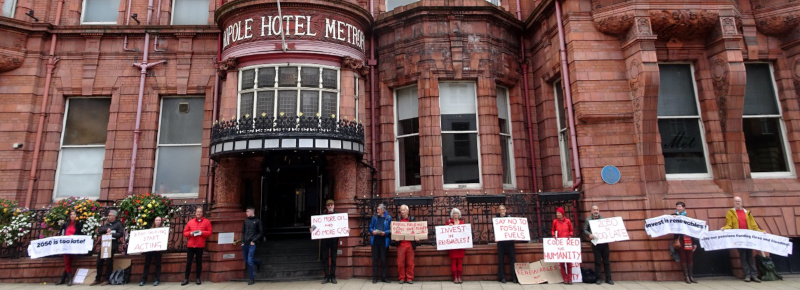 On 29th September, there were demonstrations outside the Border to Coast conference in Leeds. Protesters are angry that £1.3 billion of BCPP’s pension pool is contributing to planetary breakdown. Ironically, a scheme that is intended to provide for the future is helping to destroy it!
To conclude, Warwickshire County Council’s Pension Fund Investment Sub-Committee, consisting of just five councillors with responsibility for the Warwickshire fund’s investment strategy, has not taken action to divest from fossil fuel producers. Throughout the world, more than 1,500 institutions have committed to divestment, and in the UK, five local government pension schemes have already done so. Even Warwick District Council has divested from fossil fuels as part of their Climate Action Plan. Why hasn’t the county done the same? This is a time for all pension schemes to divest from fossil fuel producers and invest in initiatives that actually help to protect our planet. If you are a Warwickshire resident, why not send a message to the members of the Pension Fund Investment Sub-Committee today? You can do this easily by going to Warwickshire Climate Alliance’s letter campaign.
See articles like this from Stratford Climate Action in the Stratford Herald each month.


