By Peter Haine.
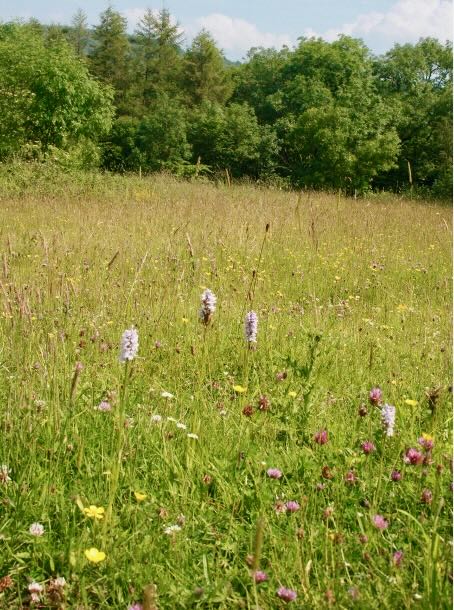 As a septuagenarian, I am old enough to remember the pleasure derived from seeing tree bordered, flower rich meadows throughout our countryside.
Sadly, between 1930 and 1984, 97% of the UK’s lowland meadows, 50% of all our hedgerows and 90% of coppiced woodland were destroyed.
Changes in agricultural practices have probably been the biggest contributor to this destruction. Traditional crop rotation, in small fields bounded by hedges, gave way to large, monoculture prairies where the crops were sustained by the application of artificial fertilisers and kept weed and pest free with herbicides and pesticides. Small woodland coppices created hazards for large machinery so they were removed.
Land taken to build homes for a growing population is another cause. As the density of housing has increased, tree-lined avenues have given way to close packed homes with smaller gardens. Increasing car use and commercial traffic has meant that new roads, wider roads and car parks are encroaching on our green spaces. The expansion of industry, and the infrastructure needed to support it has also contributed, with industrial and business parks springing up along the leafy edges of our towns.
All this growth has exacerbated the emissions driving climate change, posing further threats to our ecosystems. Emissions from vehicles, from factories, our home heating systems have contributed to a huge increase in greenhouse gas emissions – the principle cause of global warming – threatening many species already struggling, due to loss of habitat.
Together, these threats have caused the loss of 52% of our wildlife in the past 40 years. Of particular concern is the loss of pollinating insects which have declined by over a third since 2000 This threatens our food security as these insects are critical to crop pollination. Butterfly species, birds and small mammals are also under threat as many find it increasingly difficult to sustain viable populations in the isolated green spaces that remain, due to lack of adequate food and shelter.
What can we to do to alleviate these threats to our very existence and save our wildlife? Much needs to be done and there is one resource that could make a huge contribution. The charity Plantlife has pointed out that there are 313,500 miles of rural roads in the UK, mostly edged by poorly managed grass verges and scrub. Managed correctly they can help compensate for the loss of biodiverse habitats..
More than that, they can link the remaining fragile reserves to form rich, diverse wildlife corridors- able to sustain larger populations of threatened species. If we cut verges less frequently, remove the cuttings (and use them to create green energy in a biodigester) wildflowers quickly emerge, no longer inhibited by the thick thatch of cut grass. Space can be found for hedgerows to thrive, for planting trees and shrubs which add to the attraction of the route and help compensate for the loss of biodiversity in neighbouring fields and in our towns. What is more the reinvigorated verges act as a noise and air pollution barrier and help remove carbon from the atmosphere.
Plantlife are strongly encouraging councils to restore species-rich verges (*) and some are well on track. By comparison, councils in Warwickshire have been slow – let us exhort them to speed up, and help overcome UK’s sad status as one of the most nature impoverished countries in the world!
*For more about Plantlife’s Roadside Verges campaign see https://plantlife.love-wildflowers.org.uk/roadvergecampaign