 Most people who care about the climate emergency will be upset about Trump’s re-election to the US Presidency – even if plenty of us saw it coming. According to Carbon Brief, Trump’s election could lead to an additional 4 billion tonnes to emissions by 2030, or even more. He will withdraw from the Paris Agreement (again) and perhaps even the entire UN Framework Convention on Climate Change, taking the US outside the process of climate negotiation altogether. The Environmental Protection Agency will be gutted and climate science attacked.
On the other hand, it is possible some of Biden’s Inflation Reduction Act subsidies will survive, as they have been beneficial to industry in red states, and sub-Federal action by individual states may compensate for some of the damage.
Perhaps the biggest risk of all is that Trump’s style of international diplomacy – in which the escalation of tension and threat is intended to lead to a better ‘deal’ – will escalate rather than resolve current wars. Accounting for emissions from militaries, and war, is not currently required under the Paris Agreement, but numerous estimates exist. Two years of war in Ukraine, for example, are estimated to have created emissions of over 175 million tonnes of CO2 equivalent, and just the first four months of Israel’s bombardment of Gaza, led to between 420,265 and 652,552 tonnes CO2e emissions from fuel and weapon manufacturing alone.
In the UK, our responsibility will be to make sure we do not get sucked into Trump’s slipstream, either through government spinelessness, or through the election of a Trumpist. But repositioning the UK to a more independent position vis-a-vis America will be difficult for two reasons.
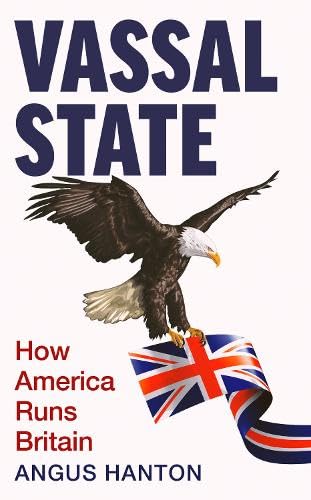 First, the vast degree of our economic, political, military and cultural dependence on America will make this very difficult. In his important recent book, Vassal State, Angus Hanton shows how under the guise of ‘liberalising’ our economy and attracting ‘foreign direct investment’, politicians since the 1970s have sold off most of our domestic companies to US private equity firms. Perhaps about £2 trillion of UK-based assets are ultimately owned by the US. This is ‘more than the total value of the FTSE 100 – the 100 biggest listed companies in the UK – and more than three times the total value of all of England’s agricultural land, or the equivalent of £53,000 for each UK household.’
This has lead to both a constant wealth transfer across the pond, as profits are repatriated, often untaxed. The total dominance of US tech firms over our information and financial networks, leads to further wealth transfers every time you use Visa, PayPal, Amazon, Uber or Deliveroo, whilst advertising revenue flies out via Facebook and Google.
Hanton is no anti-American, but objects to the inevitable undermining of our political autonomy (or, dare I say it, our ‘sovereignty’) that this situation entails. This brings us to the second barrier to a distancing from America: the often viscerally hostile attitudes we adopt towards countries that we would then have to work more closely with. In its way, Hanton’s book is a useful response to such attitudes. I think we feel able to so theatrically denounce the Europeans, Chinese, or Russians, precisely because we habitually take for granted the basic benevolence of American suzerainty over our lives.
It is precisely the refusal to recognise our American vassalage that makes climate deniers like Nigel Farage – pseudo-populists in service to the most predatory sections of American capital – a political threat. In its way, Hanton’s book may be the profoundest response to the Brexit and Cold Warrior spirit, simply by insisting on their universalisation. Once we recognise that the demand for sovereignty, or freedom, applies to our ‘friends’ as well as our ‘foes’, perhaps we will start to think more strategically about how can we reclaim control over our economic life and institutions.
I’d certainly recommend Vassal State as a Christmas present for the fanatical Brexiter or Cold Warrior in your life, or anyone worried about our relationship to America under Trump.

